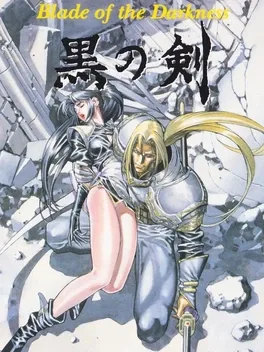
Kuro no Ken, which translates as Blade of the Darkness, is a unique entry among the works of developer Forest, in that it is their sole game targeted at the general audience rather than those interested in adult visual novels. It was released in 1995 for PC-98 and ported to PlayStation by a company called CD Bros. on October 9th, 1997.
After the nation of Kreutzen left in ruin after the attack of a pitch black dragon, the people started preparing their counter-offensive. Their weapon of choice was a magic sword, the eponymous Blade of the Darkness, which was said to be capable of slaying the dragon. A young woman named Shinobu Ryudo, clinging to the Blade of the Darkness, had embarked on a ship toward Kreutzen in order to find someone capable of wielding the soon to be legendary steel. Unbeknownst to her, the oddly named yet highly skilled swordsman Caius Neinturk had boarded that same vessel. Their fates intertwined as the ship got caught in a storm, leaving the two shipwrecked in the nation of Kreutzen.
Though Kuro no Ken is, indeed, unique among its Forest-developed siblings, it can hardly be considered unique among other games in its genre; by making use of mechanics that have been standardised in JRPGs on home consoles throughout the first half of the 90s, Kuro no Ken brings absolutely nothing new to the table. If anything, it gradually turns down the importance of its JRPG components during its early hours. Resting at an Inn is not only free of charge, it’s completely unnecessary as you replenish HP and MP through the means of walking, which you do a lot in its excessively large overworld.
Nevertheless Kuro no Ken offers a solid and worthwhile experience on its own. It alternates perspectives between Shinobu and Caius, providing its players with a magic-oriented kunoichi and a bulky European-inspired knight, respectively. Both rely equally on MP, though: whilst unable to use spells, Caius can use powerful special attacks that require relatively large quantities of MP. Apart from gorgeous works of pixelart during dialogues or cut scenes, the battles are lavishly animated as well. Attacking, evading, parrying and critical blows all have unique animations, which, despite its use of standardised mechanics, makes it enjoyable to follow Kuro no Ken’s battles attentively.
While Kuro no Ken cannot live up to the high standards of its home console contemporaries - EarthBound, Chrono Trigger and Suikoden to name a few - it does provide PC gamers with a solid, classic JRPG experience.