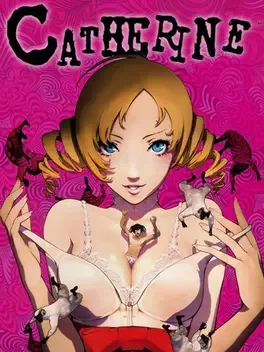
Lately, I’ve regularly discussed the game Catherine, that was - finally, needless to say - released in Europe last month. Although my activities as a game journalist have subdued ever since I started focusing on an academic career, Catherine required me to dig up my old qualities. Thanks to colleagues Niels ’t Hooft, editor-in-chief of Bashers, and David Nieborg, lecturer at the University of Amsterdam, I debuted in the newspaper nrc.next and radio broadcast Capuccino. Both opportunities didn’t provide the space to thrust forward my core argument regarding Catherine’s controversy, therefore I now refrain to my faithful blog.
As have I tried to argue in the recent Gamebites podcast (forthcoming), I find the current controversy about Catherine rather dubious. Many considered the level of eroticism, especially in relation to the theme of adultery, inappropriate and the PAL edition was rated PEGI 18+. While I understand that Catherine might greatly differ from what the audience is used to, I’d like to argue that the controversy is primarily caused by the general expectations of video games. Unlike film, which is considered a (more) mature form of media, there apparently still is a general agreement among the public that games are aimed at children - even after the controversy surrounding Call of Duty: Modern Warfare 2’s infamous Russian terrorist scene. Although one may argue that this is not the case and that games already have been accepted as a full-fledged form of media and refer to economical statistics, the very controversy surrounding Catherine suggests otherwise.
To play the devil’s advocate and counter argue my own opinion, I’d like to suggest that the relationship of players and their avatar is the source of current controversies. Unlike film, in which two actors, independent from the viewer, interact with one another, players of video games (sub)consciously identify themselves with the game character they’re playing with, like this study indicates. For instance, if Mario is being trampled by a Koopa in Super Mario Bros., the player is more likely to verbally respond with ‘Oops, I died’ than ‘Oops, Mario died’. In a similar manner, if the player’s avatar engages, or, in this case, is forced to engage in adultery, it feels more as if the player himself has succumbed to the taboo than when an independent actor in a film does so. Although I lack concrete evidence to support the following statement, I can imagine that if you are merely watching footage of an entire Catherine playthrough on YouTube, the relationship with the avatar is less firm than when actually playing it.
To advance my core argument regarding what is really controversial, I will focused on the confessional box at the end of each level. Here, the protagonist is confronted with ethical questions that need to be answered in order to advance the narrative and determine what narrative branch the player has to follow. Each time there are two answers: one is associated with law, the other with chaos, that can roughly be associated with Katherine and Catherine, respectively. For most, if not all questions, it remains highly debatable whether each answer actually represents what it’s associated with and whether it is possible to speak of such clear dichotomisations.
For instance, the question ‘You must kiss one of these. Choose’ can be answered with either ‘A cephelopod-like alien’ (Law) and ‘A beautiful corpse’ (Chaos). While many are likely to reject this question as nonsensical and bizarre, I find it rather dubious why the game suggests that xenophilia is regarded as lawfulness, while necrophilia is portrayed as chaotic. The relationship between Vulcan Sarek and human Amanda in Star Trek can be considered as xenophilic in nature, but this doesn’t justify xenophilia as more lawful than a necrophilic relationship. I deliberately picked a more universal question here, but the full list holds many other questions and answers with the law/chaos dichotomy that are as much debatable as they are personal and possibly culture-specific. The sensational emphasis on Catherine’s eroticism, which is even more suggestive than a soft erotic film, and adultery, a common trope among other forms of media, made critics overlook the actual controversy: answering questions.