Strange Journey's Deep Iconoclasm
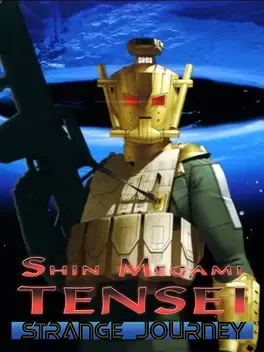
Sacred Journey. That’s how I like to call Shin Megami Tensei: Strange Journey, a dungeon crawler known by few and played by fewer. The 2010 Nintendo DS game offered a lengthy and arduous adventure through an alternative dimension on Antarctica, a stage where human and non-human met. Often in bloodshed, sometimes unscathed through hard negotiations and love-struck when you’re called Anthony. Strange Journey spoke to me on different levels when I first played it. As a game, it offered a refreshing cast of a Japanese American protagonist, a Hispanic American fellow soldier and a Russian scientist working together under supervision a Black American commander. Each of the dungeons were challenging and with close to 300 demons to team up with, the game offered a myriad possible party set-ups to experiment with. As a story, a great psychological thriller, rooted in sci-fi, philosophy and mythology. As a whole, however, Strange Journey provided me with a life-changing experience. I know the whole ’life-changing’ and ’experience’ in particular are omnipresent buzzwords these days, hence Sacred Journey. The game felt like a religious pilgrimage to find my true self (pun intended). I was in my early 20s when I started playing Strange Journey, which I had imported from North America since a European localisation never happened - a trait common among Atlus titles up until that point. My experience with Shin Megami Tensei was still largely limited to the latest Persona games, so there was a lot to learn for me as a newcomer to the series. Still, I enjoyed its mechanics and exploring the bizarre environments within the Schwarzwelt. As a Master’s student, I had little time to sink time in games, let alone advance through a game as meaty as Strange Journey at a steady pace. I frequently shelved, or had to shelve, the game in favour of writing papers, paper reading or enjoying what little social life was left. I usually put the game down at the end of a sector, where I learnt how to proceed by losing to an area boss. I knew little of Alignments in the Shin Megami Tensei series at the time. The rivalry between Zelenin and Jimenez, representing the Law and Chaos route respectively, brought about plenty of tension in an already exciting situation. After the heart-breaking scenes with Zelenin in Sector Boötes I instinctively sided with her. I tried to convince Jimenez that I wasn’t really picking sides and that she’s really been through a lot, but my arguments were insufficient to convince with the hot-blooded soldier. Over the course of the game, however, my Alignment shifted slowly but certainly from Law to Neutral, and from Neutral I slipped into the domain of Chaos. Zelenin was furious. I understood where she came from and her arguments were certainly compelling - from a human point of view. Jimenez’s offer, however, was far more appealing: he gave me to chance to examine humanity objectively from a non-human perspective. I was lured into this path by the demons that you encounter throughout the game and the areas they appear in. Each of these sectors were inspired by human sins of the modern world and named after constellations. Sector Antlia was modelled after human conflict in Eastern Europe, Sector Boötes dealt with the human lust for materialism and decadence, Sector Carina’s shopping mail represents human’s greed and capitalism, followed by Sector Delphinus’ barren wasteland to symbolise the environmental damage inflicted by humanity. While each of those sectors were unsettling and confronting on their own, the most striking example was Sector Eridanus, a peaceful garden where nature and technology harmoniously co-exist. In order to realise this utopia, humanity would have to be eradicated. A worldwide sacrifice of humans to ensure the future of non-humans. Whereas this ultimately locked me in the Chaos route for both the Schwarzwelt journey and other Shin Megami Tensei games to follow, it also determined my political stance in real-life politics. Ideological as it may seem, the realisation of such a harmonious utopia is something worth fighting for, I believe. The demons were right. Considering the major impact Strange Journey has had on my life, it shouldn’t come as a surprise that yesterday’s announcement of Deep Strange Journey, the upcoming remake for Nintendo 3DS, was a bitter pill to swallow. The characters are re-drawn by the series’ new lead artist, whose unique style I appreciate on its own but find lacklustre and paling next to his master’s master’s work. The addition of a new ending, a route represented by a new female character, upsets the natural balance of Law/Neutral/Chaos. The trailer went as far to propose a binary opposition between Neutral and Law/Chaos, making room for an allegedly third movement. Furthermore, a new animation sequence demonstrating a fight between Morax and Asura makes absolutely no sense in the context that both demons are are on the same side, criticising humanity’s lust to fighting among themselves. While I appreciate Atlus’ attempts to re-do older titles to make them better accessible for the current generation of gamers, I wish they focused on games from their library that would actually benefit polishing, such as the original _Devil Summoner _or perhaps a high-definition re-release of Raidou Kuzunoha. To a fan of the original, Deep Strange Journey feels like a lazy and un-inspired attempt to earn relatively easy cash to feed the ever-growing Persona cow. I loved Persona 5 and will never stop looking forward to a sixth entry in the series, but please… Do not ruin my Sacred Journey. *** Strange Journey had such a major impact on me that I used it as my case study for my Master’s thesis. What follows below is an excerpt of the introduction: ...